
.png)
language utilization
Public Signage
by Hayato
This page will discuss the various language utilizations of public signboards
public signboards
Signboards which are issued by public organizations (e.g., government, district bodies…) that are not utilized for business / profit intentions
Introduction
Various impressions can be made by the viewers towards signboards, depending on its’ various features. For instance, content can be one influential factor, as depending on the used terms, viewers may have a positive, or a contrary negative impression towards them. Language utilization is also a significant feature. Despite having the same content, viewer impression may alter depending on how it is being conveyed. For instance, 「禁煙」(translates to ‘No Smoking’) and「喫煙はお控えください」(translates to ‘Please refrain from smoking’) would have completely different impressions despite discussing the same content (details discussed later). Likewise, this page will discuss the various types of language utilization and how viewer impression are likely to be.
IMPERATIVE (~禁止)
When we communicate, we would often ask our interlocutors to do things or take some action. In this case, we would generally have two cases in our disposal: one to give an order, and the other to make a request (Yamaguchi, 2007). This subsection will discuss the former.
When one asks the interlocutor to do something, addressees are usually expected to comply with that certain order. Moreover, inquiries made in the imperative form would have a stronger connotation. Imperative forms in the Japanese language are generally divided into three categories: verbs added with the -e, -ro suffixes, verbs added with the なさい (nasai) suffix, and verbs added with the な (na) suffix (Yamaguchi, 2007). However, the public signboards falling under the three categories were not common. Instead, an alternative type of imperative language were commonly observed in the district, which were texts ending with -禁止 (kinshi, translating to prohibition).
The general template of this language utilization is that 禁止 would often be later attached with a certain action. For instance, the term 駐輪禁止 (which translates to no bicycle parking), is a combination of the word 駐輪 (bicycle parking) and 禁止. Likewise, the verb stem of this case would “to park a bicycle” which is later attached with “prohibition”. This category was the most observed language utilization for public signboards that are intended to ask viewers to refrain from doing a specific action.
The language utilization of the imperative form can also suggest an interesting hierarchical aspect of the publisher (in this case the government) and the public. Usually, people would not use the imperative form of language towards those of their superior or a complete stranger. Moreover, when one uses an imperative form of language towards another, they would usually be in the superior side (in terms of age, business positions…) compared to the other. In this case, the government and the public would technically be in a relationship of ‘strangers’, as the government does not know each and every individual and vice versa. Nevertheless, these public signboards are written in the imperative form, suggesting how the government is positioning themselves as more ‘superior’ to the public.

Signboards calling for
駐輪禁止
(no bicycle parking)


HONORIFICS / FORMAL
Earlier, we’ve discussed how two disposals can be given when one asks the other make a certain action: one to give an order, and the other to make a request. This subsection will discuss the latter.

Signboard calling for the awareness of kyakuhiki

Signboard calling for the awareness of kyakuhiki (text in red)
The language utilization of honorifics (=敬語 keigo) can be used in various situations for various purposes. According to the Agency of Cultural Affairs of the Japanese government, honorifics are used in order to ‘display reciprocal respect in a relationship’. This term ‘respect’, is not only applied in the sense of admiration but is also applied to honor one’s social position. Therefore, considering the variety of the public in terms of age, occupation, social position and etc., the use of honorifics would be significant in order to display the sense of respect from the government towards each respective individual. Likewise, several signboards using honorifics, were observed in the district.
Left are two signboards which both call for the public to be aware of kyakuhiki. The use of honorifics can be observed in both signboards (left - ~です (desu), right - ~ください(kudasai)). Nevertheless, the difference in tone between the two are also sensible. The signboard on the left side seems to be applicable of the display of respect towards the viewers as it is requesting to do a certain type of action (in this case, to be aware of kyakuhiki) with honorific language. Moreover, the exclamation mark also adds the sense of shock and emphasis to the statement (according to BBC), which adds an exciting connotation to the text. On the other hand, the signboard on the right seems to have a more serious tone compared to the one on the left. In terms of content, the text in red says “客引きは条例違反です。” translating to “Kyakuhiki is against by-law.”. This statement alone does not directly ask the public to do anything in particular, nevertheless, can be perceived in a way how kyakuhiki should be something avoided.
Moreover, the statement has a punctual period in the end, which is not commonly seen in signboard texts. Linguist John J. Gumpertz proposes the idea of “situational code-switching” where people alter the way they speak depending on where they are, who they talk to, and the platform they are communicating on. The use of a period can be one example of situational code switching, where such use on signboards may be considered overly formal with the emphasis on the statement.
AGENCY / SUBJECT OF ACTION
Discussing legality, the agency of public signboards would either be the authority (the government) or the audience (the public). For instance, if the signboards ask the public to do a certain action, the agency would be the public. On the other hand, when the signboards notice that they will execute some sort of punishment to those who broke the regulations, the agency would be the authority. Depending on the agency of action, impressions towards the signboard would differ; often the latter to be more strict than the former. This subsection will provide two examples from the signboards observed, and analyze its’ difference in viewer impression.
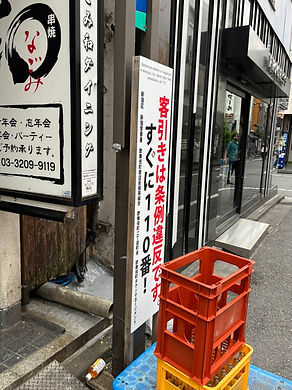

Image A
On the other hand, the signboard on image B declares the penalization of a fine to those who parked their cars around the area. As the authority are the ones to declare the punishment, the agency of the signboard is on the authority. Thus, the viewers would not have the freedom to choose whether to pay the fine or not (they would HAVE to pay the fine), suggesting its’ strong tone in seriousness and having a stricter viewer impression than the one on image A.
Image B
LANGUAGE
Understanding the written language of the public signboards will help us understand who the audience is, and for whom the signboards are intended to be shown for. Public signboards observed in the district were generally written in Japanese. However, considering the district’s emergence of becoming a tourist hotspot in recent years, English descriptions were also observed in some of the signboards.
Moreover, differences in language use were also observed within those who fall under the same categorization of bilingual signboards. Some signboards were found using English for attentiveness and catchy-ness while other were found using for translations.
For instance, the signboard on image A is a public signboard that calls for prevention of littering in the district. The Japanese text says “ビン・缶・たばこ・ガム・紙くずのポイ捨てやめよう” which translates to “Let’s stop the littering of glass bottles, cans, cigarette butts, chewing gum, and paper trash.”. Meanwhile, the English text says “Clean Shinjuku”, which merely does not translate what the Japanese text says. Rather, this seems to be more of a catch-phrase of the signboard from its’ simplicity and shortness of the text. However, the main message of the texts in both languages are common, which is to make the district a clean place.

Image A

Image B

On the other hand, the signboard shown in image B and image C is a different case. Image B shows a public signboard which calls for the awareness of kyakuhiki to the public. The main text is written as “客引きは条例違反です。すぐに110番!” which translates to “Kyakuhiki is against the regulations. Call dial 110 immediately!” Image C is a close up image of the English text of the same signboard. As we take a close look at the text, it is the direct translation of what is written on the main text in Japanese. From the comparison with the previous example, we can see how despite both signboards being bilingual in text, the content that are shared between the two languages are different, depending on each signboard.
Image C
Close up on the English text of signboard on image B
Conclusion
This page discussed the various language utilizations of the public signboards observed in the district. Moreover, depending on the variations in such utilization, we were also able to analyze how viewer impression can widely vary as well. Considering the audience of public signboards to be entirely homogeneous (with various age, gender, occupation, social position and etc.), language utilizations are likewise to vary as well. However, although viewer impression is likely to vary, our observations did not focus on the viewer reaction in particular. Therefore, we were not able to collect and present such data for this research project, which we hope to do so in the near future.