
Verbal Communication
Begging
by Lana
Introduction
“Please give me 30seconds” (30秒でいいから時間ください)
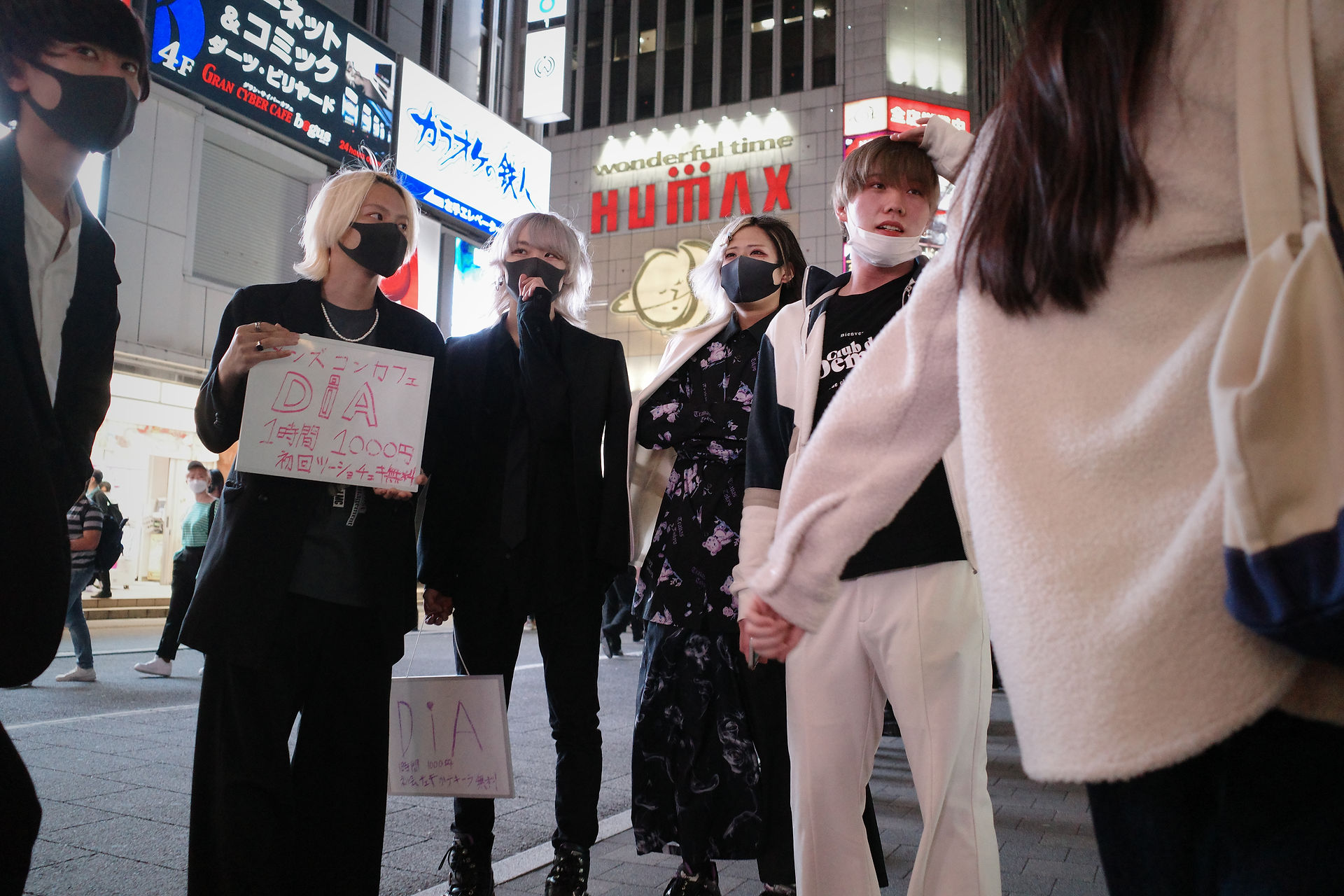
Walking down the streets of Kabuki-cho, you might hear the scouts saying such thing to their targets.
You might wonder, “Why would they beg to their targets? Don’t they feel miserable?”
However, that is exactly their strategy: to make themselves seem miserable and lower in hierarchy.
Although there are positive and negative sides to this strategy, they specifically utilize it for specific targets to convince them to work in the industry.
Which targets are frequently begged by the targets?
Girls with revealing outfits

As observed in the flowchart, begging frequently can be seen towards specific types of targets such as girls with revealing outfits.
Analysis
Why do they use this strategy towards specific targets?
The factor to note here is the targets’ outfit. Compared to the majority of the female Japanese population, this group wears clothing pieces that relatively reveal their body parts. There is a societal stereotype in Japan that women with more revealing outfits tend to be more experienced in intimate activities. This concept plays an important role for the scouts’ decision making of whether to recruit a target or not. This concept is not necessarily always true, however, it is some extent accurate these women possibly could be more comfortable in their body which becomes a crucial factor once one starts working as a worker. Scouts consider this as an important quality of a worker, therefore, they put more effort into scouting this type of targets. Regardless of the scouts’ awareness of this societal stereotype, it is greatly affecting their recruiting process.
Let’s now look at the different effects that begging has to analyze what kind of role scouts are attempting to portray to these targets.
➕Positive
1. Lower status in the hierarchy
The scouts purposefully lower their status in order to regain the possibility of successful scouting. Although they are well aware that this is most likely not going to work, they give it a shot regardless. In addition to this, it creates a sense of superiority among the targets which may allow them to consider the job offer depending on how the process is carried out afterwards.
“Onee-san please, I know you’re busy but just give me a chance and you will understand.”

This is a line spoken by a scout in Kabuki-cho. The female target seemed rather uneasy about the fact that the scout called on her. However, when the scout said this, she suddenly seemed more comfortable with the scout. Before she was walking faster completely ignoring him. However, this begging method influenced her walking speed and even made eye contacts with him. Even though the scouting process did not end in a success, we can observe the positive effect of the begging method.

2. Obligation
Combined with the term “Onee-san,” it creates the sense of obligation where the targets feel the need to listen to them. As mentioned in the 🗣️Calling section, scouts utilize the adorable younger brother effect for creating a more difficult situation for targets to ignore them by making them feel guilty.
3. Platonic familiarity
Begging is usually done when one is in a relatively close relationship with another. Especially in Japan, there is a tendency to avoid begging because it is considered to be embarrassing. However, scouts beg regardless because they are attempting to portray it as a friendly request.
“It’s fine, just a little bit. Aren’t we close? I’m struggling a little bit right now.”

⬆️One of the scouts who approached me in Kabuki-cho asked me a “friendly favor” by saying this line. It is a weird situation for a complete stranger to mention how close we are. Although it made me slightly uncomfortable, at the same time it also had a suggestion (暗示) that we were somewhat close. It might have been the way he approached me or the facial expressions that assisted the effect of the line. However, it certainly had some kind of effect on me to feel closer to him.
➖Negative
1. Pity and Judgement
Oftentimes the targets pity the scouts because they use the begging tactic when the targets have been refusing them all along. It could be connected to the positive feelings such as sympathy and empathy because they have a difficult time recruiting the targets, but mostly it is connected to pitying them.
The judgement comes from the fact that they are not suffering financially like the street beggars, yet continue to use the begging method in order to successfully make more money. It is simply a tactic for them. According to Ojo and Benson, begging has an effect on the beggars to lose self-respect and dignity. Scouts are pretending to act as this suffering beggar when in reality they are not.
2. Insistent
In relation to pity, some might be annoyed by the begging strategies if they have no interest in considering entering the industry. To avoid such negative consequences, scouts sometimes avoid using this tactic to certain targets because they are aware of this possibly happening.
For further details, check the 🪜The Steps of Persuasion section.
Conclusion
Stereotypes and prejudice have a pervasive and often pernicious influence on our responses to others, and also in some cases on our own behaviors (Stangor, 2022).
Scouts’ strategies are both consciously and unconsciously influenced by the cultural and societal concepts/stereotypes in Japan. These concepts facilitate their decision-making within their recruiting process.
In addition, from observing the different impressions the begging method produce, we can conclude that scouts intend to portray themselves as a pitiful beggar who is struggling and is eager to do anything for successful scouting process.
Although the connection between the specific type of targets and the intended role scouts ae playing, it is clear that the scouts consider this method as rather useful for targets with revealing outfits.
Sections
Verbal Communication