.png)
Heterosexual inclusion/exclusion (Momo) TOP PAGE
Introduction ~Heterosexualization of Nichome~
In a heteronormative Japanese society, straight identity is almost always presupposed to the point heterosexuality has become the basis of family and society (Dean, 2016). Being straight therefore is understood as “normal and natural” as opposed to homosexuality appears challenging and norm-breaking to many Japanese people to this day. For this reason, in a heteronormative society, gay bars and clubs “offers an opportunity for meeting gay partners as well as for inhibition-free socializing and organizing” (Matejskova, 2017, P.139).
Nichome’s Dilemma
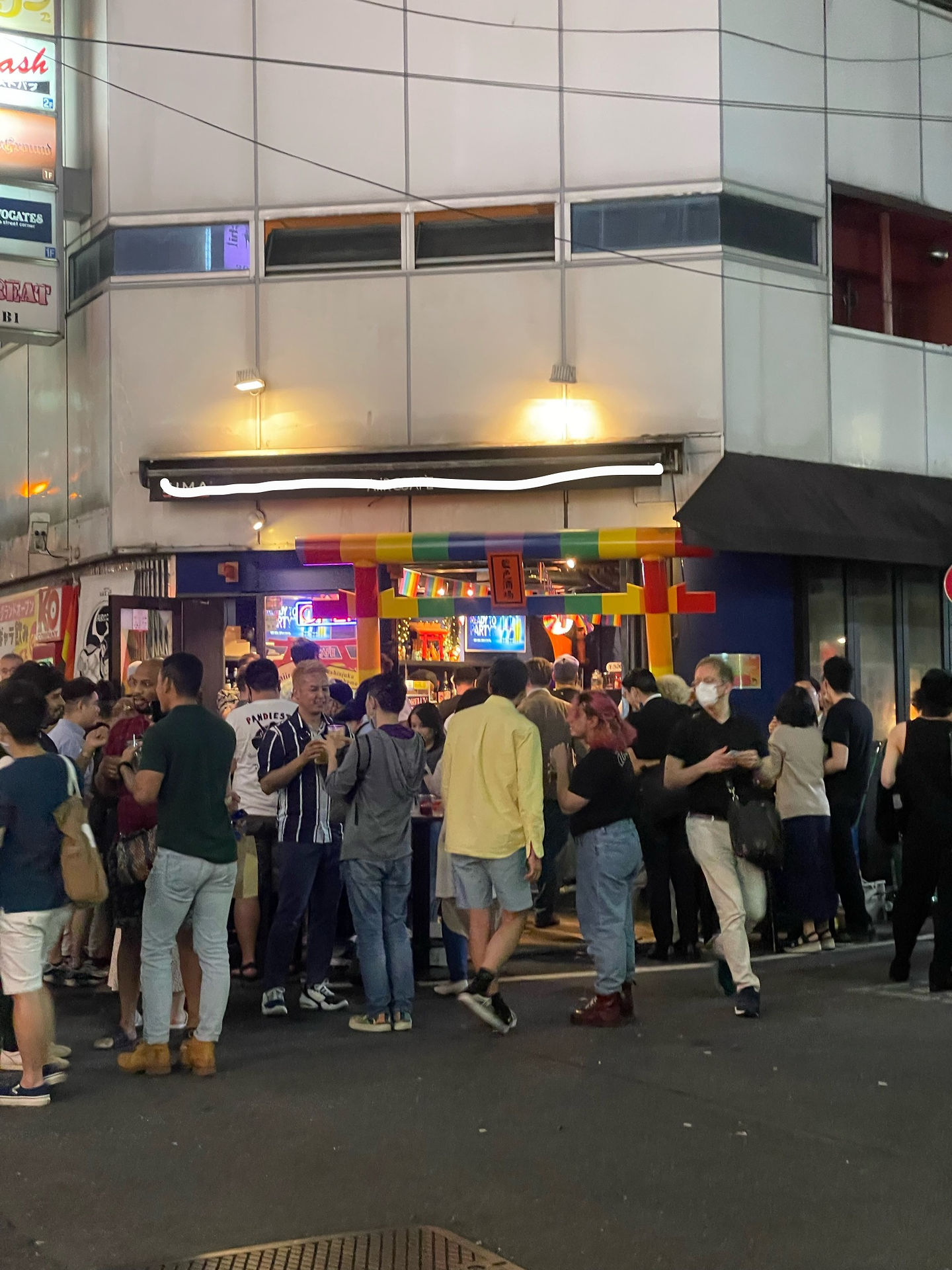
In the previous section, an increasing number of heterosexual visitors to Nichome were presented as a risk to straight insiders who seek refuge from the heteronormative world. Similarly, the influx of heterosexual customers in queer spaces has been viewed and studied as a threat to the gay community that deconstructs the safe and comforting nature of gay dominant spaces attributed to its exclusivity (Casey, 2004; Hughes, 2002). For this reason, it has been often perceived as inappropriate and invasive for straight people to visit gay/lesbian bars.

However, the advent of online dating sites for sexual minorities -equipped with advanced privacy protection- has taken away traditional gay customers from gay bars in Nichome ( Sunagawa, 2015). On top of that, with the coronavirus pandemic and the following restriction on nightlife activities, the Nichome business now needs to seek any available economic opportunity -including straight tourism- more than ever.
Dilemma: ノンケ tourists play a significant role in Nichrome's economy while at the same time they pose a threat to the gay community
“It is not possible to have new inclusion in ‘gay space’ without creating (damaging) exclusion” (Casey, 2004,p.453 )
In contrast to this claim, as a female outsider visiting Nichome, I have experienced different types of exclusion carrying different degrees of damage to straight visitors. This experience underscores by excluding heterosexual visitors in the right space and at the right time, “gay spaces” will be able to meet the needs of straight people without diluting the gay identity of the space, thus protecting the safe and comfortable nature of Nichome for the insiders. In other words, by maneuvering exclusion and inclusion, Nichome has the possibility of achieving harmony among gay insiders and straight outsiders.
Therefore, this section offers an alternative conceptualization of heterosexual people in Nichome by addressing the perspective of both homosexual insiders and heterosexual outsiders. Academic and media attention in regards to Nichome has been paid overwhelmingly to the LGBTQ+ community and their viewpoints, failing to represent the diversity and complexity of the Nichome population. Thus, this section aims to reach beyond the common narrative of Nichome as a gay town, by shedding light on straight patrons. The page first determines the needs of gay insiders and straight outsiders, then outlines the current hetero inclusion. Finally, in the last section, employing the responsive theory of exclusion by Freeman et al. (2016), we present a possible way to achieve harmony in Nichome through the appropriate practice of exclusion.
Subsections
The Ways Straights Walk Their Way into the Gay community (Actors of hetero inclusion)
Heterosexual Exclusion