.png)
by Christina
.png)
INTRODUCTION
With gay bars concentrated within the district, Shinjuku Ni-chome is distinguished as one of the main bases for accommodating the LGBTQ+ community in Japan. However, what sets Ni-chome apart from other gay districts such as in the West or Australia is that it is used “only as a temporary refuge, a place for amusement and leisure, by gay men and lesbians” [emphasis added] (Susaki, 2021, Abstract); in other words, contrasting with the gay districts in the West or Australia which serves as an opted home to the gay and lesbian community, the marginalised LGBTQ+ community in Japan–a rather conservative country–prefer not to live in Ni-chome for mainly the given reasons:
-
Poor living environment
-
High cost of housing
-
Risk of coming out
-
Lack of LGBTQ-related organisations that offer support
Against this backdrop, with the concentration of gay businesses in the area, service providers in Ni-chome play a critical role in creating and reinforcing a so-called ‘safe space’ as well as a place for community-building for the LGBTQ+ individuals who seek refuge–although temporary–in the predominantly heteronormative society. With the declining physical gay communities due to digitalisation (McNeill, 2010), gentrification or as some may describe as ‘gaytrification’ (Deck, 2017), as well as plummeting profits of businesses during the current COVID-19 pandemic (Lies, 2020), service providers in the area must consider the gay district’s survival and revitalisation. With such events, through the commercialisation/commodification, the prominent gay district of Tokyo has established itself as a branded community, one which excludes people but simultaneously includes and aims to keep people in.
RESEARCH FOCUS
Why are services important?
Services is an epitome where there is a merging of the human side with the capital side; of the private self and the commodified public self.
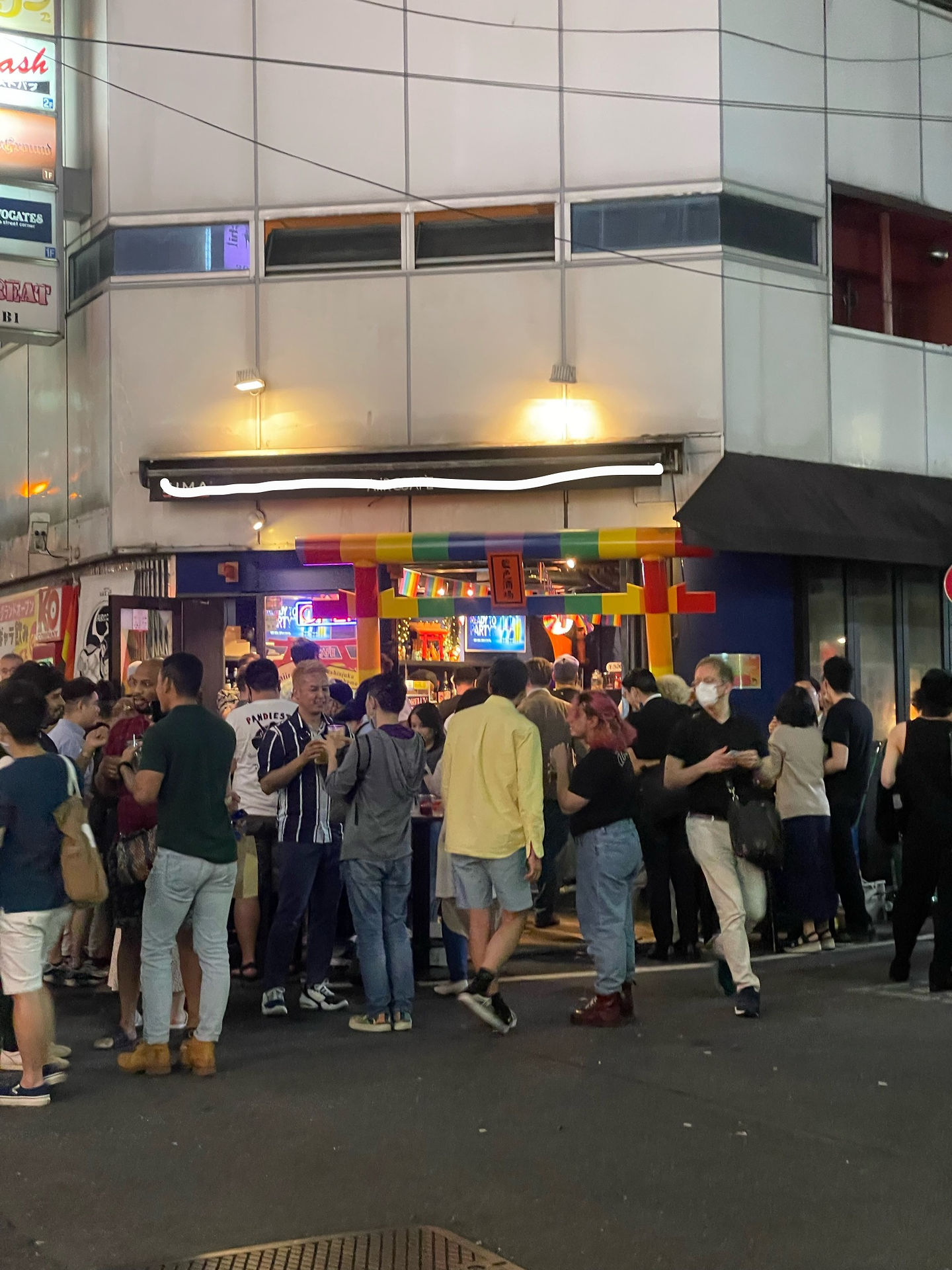
Although multiple types of services are provided in the gay district, this page will delve deeper with the purpose of further understanding how service providers working at bars and clubs at Ni-chome include individuals regardless of their sexual orientation through action, linguistic registers, as well as nonverbal communication with the purpose of bringing them into the uchi. The page will further analyse the ‘unwritten rules’ of accepted behaviours–enforced by service providers–within the given space.
SERVICES PEOPLE IN NI-CHOME CAN ENGAGE IN
As abovementioned, the foci of this page are bars and clubs. In specific, referred bars and clubs throughout this page include gay bars, lesbian bars, as well as drag queen bars.
Apart from such services, there are other services that people can engage in at Shinjuku Ni-chome, depending on their objective.
Read more on Actors in Ni-chome
and their Activities.
Bars & Clubs
Some places function as both bars and clubs depending on the day of the week.
It is also important to note that some gay bars, lesbian bars, as well as drag queen bars can be categorised as mixed, as these places welcome patrons not specific to their target. In contrast, there are some places that use membership to exclude those who are not part of the community.
Read more on Members-only bars and how built environments and urban place contributes to such segregation.
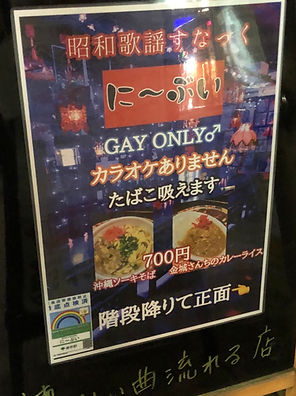
Gay Bars

Depiction of male homosexual love
Lesbian Bars

Drag Queen Bars (Okama Bars)

“GIRL MEETS GIRL”
Adult Stores
Adult stores in Ni-chome specifically sell male pornographies. Thus, as depicted, the customers who enter these facilities are male.


One of these adult stores explicitly states that women are not allowed
– “DVD sales floor ONLY MEN”.
Beauty Clinics & Salons
Although some beauty clinics targeted a wide range of demographic, there were some beauty salons that explicitly addressed males.


Men’s hair removal salon
Hotels
Business hotels around the area allow for salarymen, who approach the district after working hours to protect their personal identity in seeming proper (Karp, 2015), especially in the conservative country.


Ethnic Restaurants
It has also been observed that there is a prominence of specifically Thai and Taiwanese restaurants around the area. This perhaps could be due to 1) Taiwan being the first Asian country to legalise same-sex marriage in 2019 and 2) the existing transgender culture in Thailand, being one of the most famous places for gender reassignment surgery (i.e., from male to female) (Aizura, 2010).

.png)
Massage Parlours
Unlike massage parlours in Kabuki-cho, which employ female masseuses, the ones visible in Ni-chome are advertised as male masseuses giving male patrons massages.

Looking into the different services, the spatial manifestation of sexuality tends to be highly gendered. As Wilson (2014) writes, “networks organized around female same-sex sexuality (e.g., lesbians) have often been less public than male or male-to-female transgender communities […]” [emphasis added] (p. 204). As shown from the images below, in essence, these services, too, cater more toward male-bodied people.