.png)
Built Environments & Urban space
by Moe
INTRODUCTION
Urban Gay Communities in Decline
Urban gay communities worldwide have been experiencing a general decline throughout recent decades, especially with the dawn of the Internet Age.
In fact, a 29-person study by AIDS Care (2008), conducted to “identify how urban gay communities are undergoing structural change, [and] reasons for that change”, found that all participants—with the exception of those from New York and London—recognized structural declines driven by the Internet. “[Gay communities are] becoming Internet-based and away from public participation”, “[there are] less parties and more party by the Internet”, and “more people are online doing their own thing” were among the answers provided by the respondents. The informants also described a visible change in the bar and club scene, with the numbers of bars and clubs drastically decreasing, along with their popularity, while the customer demographic shifted from “totally gay” to “mixed”. Due to declining patronage and physical visibility of gay individuals, participants from all cities estimated a larger online gay community, relative to their offline counterparts.
Bringing physical gay communities into a further decline is the ongoing COVID-19 pandemic that has stagnated economies in many urban cities. As stringent shutdowns meant no revenue, many bar-owners worldwide—unable to pay rent and wages—were forced close down. Even if the pandemic nears its end, gay bars will be unable to “afford to re-open at a lower capacity if social distancing rules were mandated” (Savage, Lavietes, & Anarte, 2020).
Having discussed the broader picture, what is the specific case for Japan’s largest gay district, Shinjuku Ni-Chome?
The Case of Shinjuku Ni-Chome: A Branded Community
Shinjuku Ni-Chome has also undergone a structural decline with the increased influence of virtual communities, in tandem with COVID-19. Ryu Susumu, the author of the manga comic Vanishing Shinjuku Ni-Chome, blames love hotels and online hookups, citing the end of Japan’s famous gay magazine Barazoku as “a symbolic event when the internet overtook gay culture” (McNeill, 2010). The government-mandated state of emergency during the pandemic also contributed to the district’s decline, with some bars’ profits plummeting by 95% since pre-COVID times (Lies, 2020). Metropolis author Andrew Deck (2017) further argues that the completion of the Fukutoshin Line—which significantly improved Shinjuku Ni-Chome’s accessibility—gentrified (or, “gaytrified”) the area, making small bars less viable.

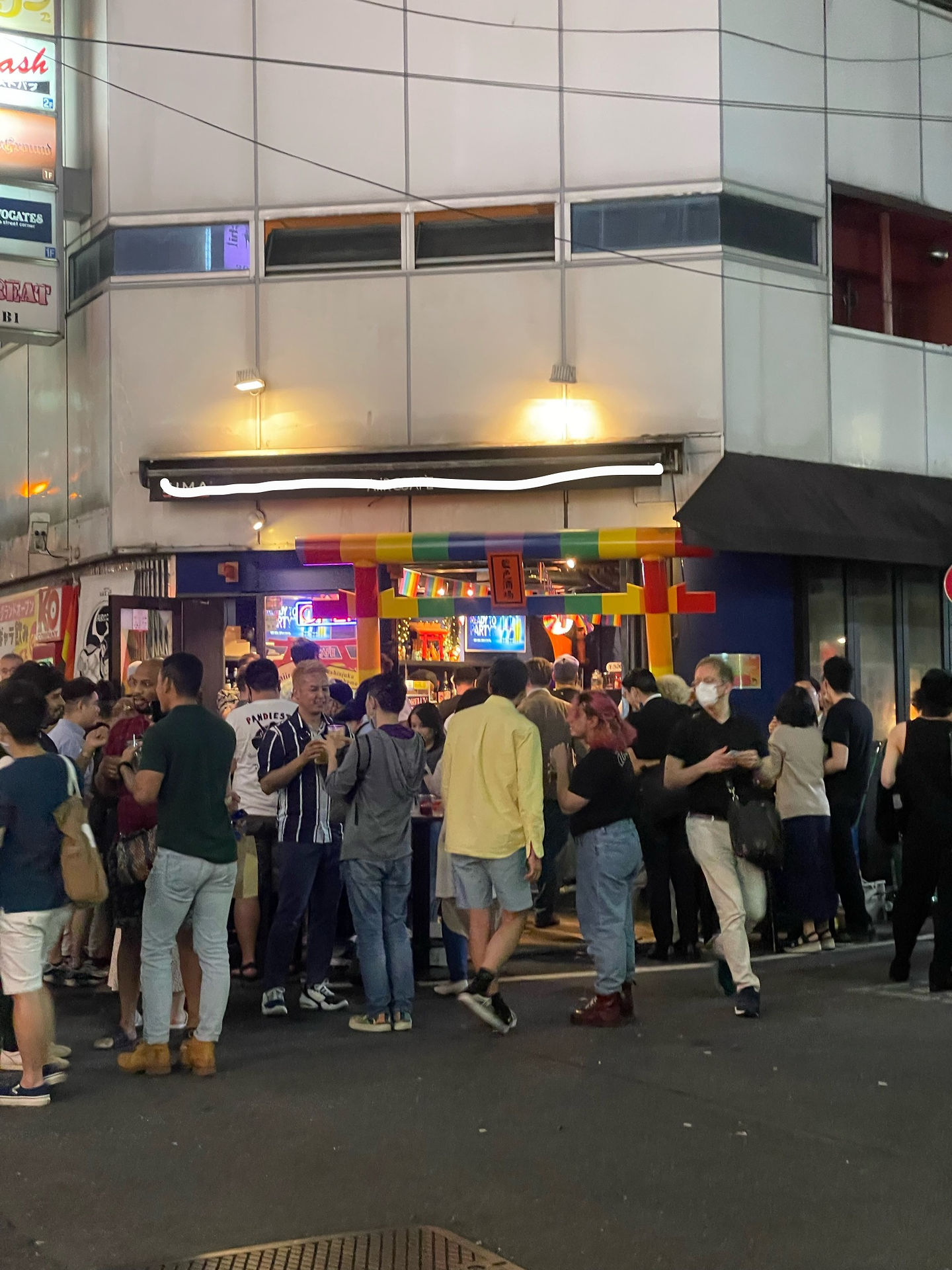
Against this background, Shinjuku Ni-Chome has commodified its space to tackle the decline, establishing a branded community of having to bring people in, while also keeping people out. The former is necessary to revive the district’s once-vibrant and crowded nightlife, while the latter is required to preserve some form of community for queer individuals. This dichotomy is perfectly summarized by the bar owner, Taq Otsuka:
“I think Ni-chome is opening itself up to the realities of the time. As a result, straight women have become some of the neighborhood’s most frequent patrons, walking a fine line between treating Ni-chome as a spectacle and genuinely investing in the community” (Deck, 2017).
RESEARCH FOCUS
Built Environments & Urban Space
With the afore-described branded community in mind, this research for the Shinjuku Ni-Chome project will focus on how built environments and urban spaces contribute to the dichotomy of having to bring people in, while also keeping people out.
Urban space is worthy of analysis for this research, as sexual identities, relations, and meanings construct physical and symbolic space (Forest, 2002, as cited in Lashkari, 2018), creating an interconnected relationship between queer identity and Shinjuku Ni-Chome (Ferraria, 2012, as cited in Lashkari, 2018). Within this space are built environments, which also plays a role in the branded nature of Tokyo’s gay district. For clarity, the definition of built environments is as follows:
“[The built environment] is an abstract concept, [referring] in the broadest sense to any physical alteration of the natural environment ( . . .). Generally speaking, it includes built forms, which are defined as building types (such as dwellings, temples, or meeting houses) created by humans to shelter, define, and protect activity. ( . . . ). Built forms may also refer to specific elements of buildings (such as doors, windows, roofs, walls, floors, and chimneys) or to spatial subdivisions of buildings (such as rooms-their sizes and function, arrangement and connections)” (Lawrence & Low, 1990).
Built Environments & Urban Space