.png)
Maneuvering of Sexualities (Karen)
Actors in Nichome
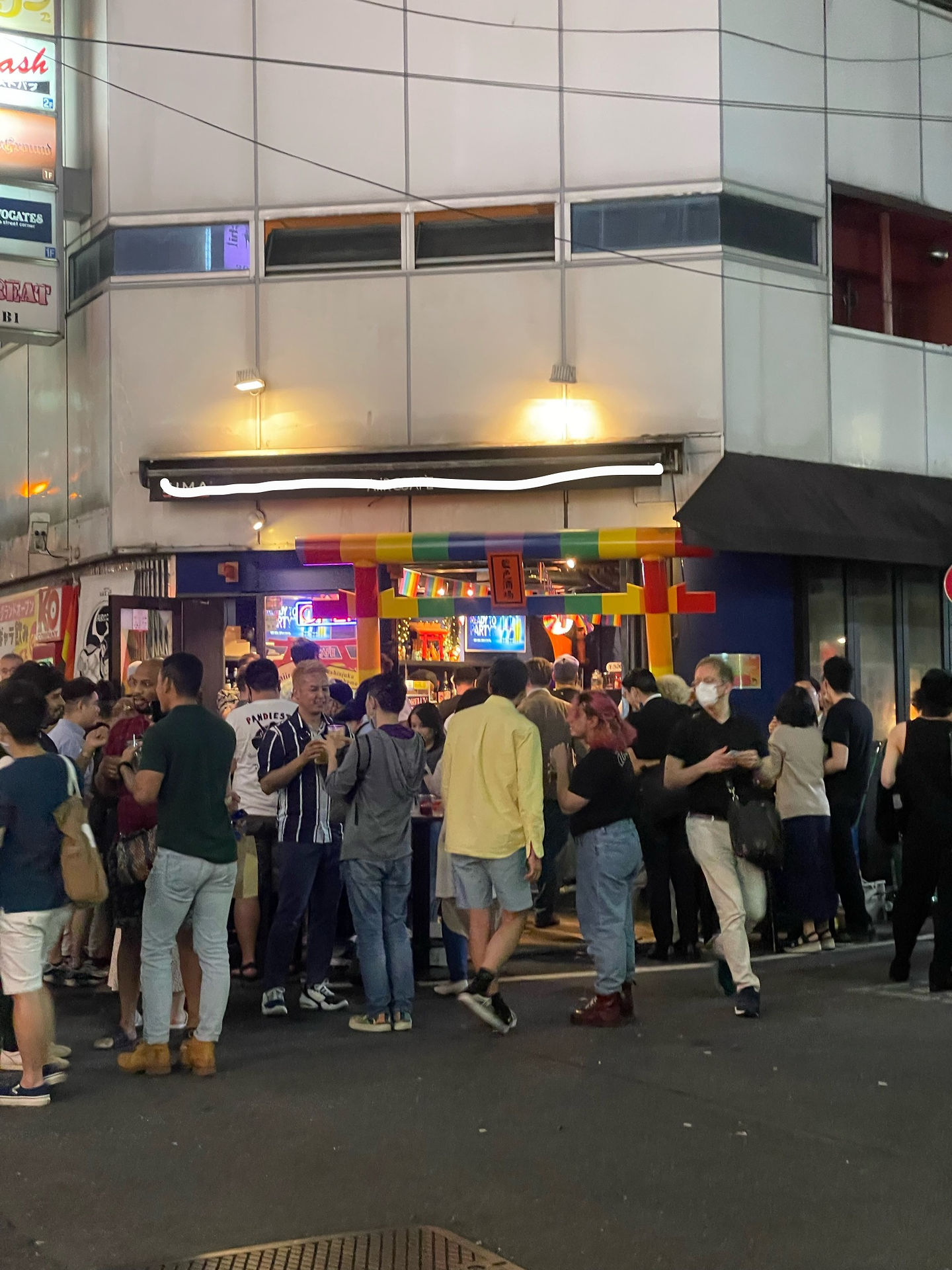
What comes to mind when you think about the people of Shinjuku Ni-chome? Stereotypically you may think of anyone a part of the LGBTQ community which are lesbians, gays, bis, and transgender people. You may even think about how your straight friend went there to see this mythical place. But, if you’re a researcher observing all of the people that pass by you, you will notice the foreigners, different types of workers, heterosexual couples, and so much more. Different actors have different objectives as well as a specific role in this vast community. Each gay patron or drag queen bartender is a part of the play that is “A Night in Ni-chome”. In this section, I will introduce the insiders, staff, and outsiders of Ni-chome to find how each actor plays a role in this idea of risks of sexualities.

Insiders: Regulars
What is labeled here as “insiders” points to those who are familiar with Ni-chome and frequent Ni-chome to the point where they seem comfortable with the place. This includes gay men which are categorized into younger and older men. For older gay men, what was observed in gay bars was mingling with long-term friends as they were seen drinking and bar-hopping. The younger gay men, however, seem to have varying objectives according to individuals, which will be discussed in the latter part of this page. There were also foreigners, who were seemingly gay/lesbian as well as drag queens and cross-dressers. Although not many lesbian people were observed in my field research, there were lesbians certainly in a lesbian bar I visited. They seem to be there mingling and drinking.
👨🏻 Younger Gay Men
The younger gay men are anyone that is on the younger side so perhaps from 10s~20s. They are the dominant group in Nichome and are found in many gay bars and other places where men are welcome (Adler & Brenner, 1992). They have a wide range of activities from drinking, and making friends, to enjoying entertainers.
👨🏻🦳 Older Gay Men
Fukesen are also a major group in Ni-chome as they are older people with more time and money (Lunsing, 2005). They also do not have many places for gay socialization in their personal life so according to Lunsing, they find socialization in Nichome (2005).
👸🏻 Drag Queens
Drag queens are usually biological men who use exaggerated feminine clothes and make-up for entertainment purposes. Drag queens are, I observed, primarily workers in drag queen or even gay bars. Although my fieldwork is limited in the sense that I did not get to observe many of the drag queens, I found that they have a strong presence in Ni-chome
👨🏼🦱 Foreigners
Foreigners, usually male and homosexual, are a rising population in Ni-chome. Since the rise of Ni-chome involved foreigners, there is still a sort of place for them in Ni-chome (Batin et al., 2017). Their purpose is usually the same as the young gay men. What is further is that many of them perhaps find Ni-chome more comfortable, a fact that needs further research.
👘 Cross Dressers
Cross Dressers, or people in Jõsõ (女装), are an established phenomenon (Kinsella, 2020). There are biological men who enjoy dressing in feminine wear and it does not suggest that every person is transgender. A few cross-dressers were observed but this is also a phenomenon that needs to be researched further in another study.
👱🏻 Lesbians
Although I was unable to look too deeply into the lesbians in Ni-chome, there definitely were a few, specifically in a popular lesbian bar. There is not a prominence of women in Ni-chome due to reasons such as biologically women do not seem to need a community to support their ideologies as well as the physical constraint of time, as many women are mothers (Brenner, 1992).


Staff and Workers
In Ni-chome, although there are a lot of people that can be categorized as insiders or outsiders, there are those that simply are there as it is their job. These are the staff, the bartenders, entertainers, and catches who are presumably a part of the LGBTQ community. The bartenders and store owners are key players in social interactions between the insiders, as well as the outsiders. As explored in the heterosexual inclusion page and the services page, these people hold a dilemma in the sense that they must think about the economics and business and try to lure in as many customers as possible, while at the same time minimizing their risks in outsiders/strangers interactions. The entertainers, at least the ones I met, were usually a part of the LGBTQ community, with gay male strippers being a significant part of the entertainers’ population. They are there to entertain people in the same marginalized community as themselves and at the same time are getting paid to do so. Therefore, they perhaps also hold this dilemma of which side to choose; the insiders or the outsiders. Lastly, the okama and onabe catches seemed to be a part of okama and onabe bars. The one instance I saw a successful catch was when an okama catch was luring in a heterosexual couple. Therefore, they perhaps are also seeing this as a business, trying to find the most willing person, no matter their status in Ni-chome, to come into their bars and give them profit. Overall, the staff and workers of Ni-chome are in the middle of the exclusion/inclusion dilemma, as they must constantly maneuver between the insiders, who they identify with, and the outsiders, who give them money.

🧑🏻 🍸 Bartenders

🧑🏼🦳 Store Owners

👯 Entertainers
🤵🏽 Okama/Onabe Catches

Outsiders: Temporary Visitors
The outsiders of Ni-chome, I explain here are those who are in Ni-chome for a temporary visit which lasts maybe a night or a few nights, depending on the motives. I define them as outsiders when they are not necessarily included inside the communities that are created in Ni-chome and they seem to not be comfortable in the city. Some prominent outsiders are first, heterosexual couples. There is actually such a vast population of heterosexual couples. However, a common characteristic of them is that they are usually physically looking around and walking around the city, suggesting their unfamiliarity with the place. Speaking to some patrons and bartenders, their purpose many times seems to see the “infamous Ni-chome” or to find a comfortable place to drink. Therefore, their purpose is more narrow than other homosexual patrons. There are also the friends of patrons, who are essentially friends of the LGBTQ community that get brought to certain places to explore. One particular instance I observed was a gay regular, bringing in his straight friend who has a girlfriend to a popular gay bar. They were drinking and conversing with the bartenders throughout the night, suggesting their motive was to hang out and drink. Lastly, there are people who come with economically advantaged men, a.k.a sugar daddies. There were a few couples who had a major age difference walking around the streets but I was able to converse with one couple with this exact relationship. Their purpose for being in Ni-chome was primarily due to the woman’s curiosity and the man’s regular patronage of a certain gay bar. Therefore, as these types of relationships suggest, there are many people who go to Ni-chome for a temporary night out.

👫 Heterosexual Couple

🧑🏻🤝🧑🏽 Friends of Patrons

👨🏻🦳 👱🏻♀️ People with Rich Men
As this section’s primary focus is on the maneuvering of sexualities for insiders, for more information on heterosexual actors, the outsiders, in Ni-chome, click here: Heterosexual Inclusion.
Conclusion
This page has illustrated that there is an abundance of types of actors such as homosexual people, heterosexual people, workers, etc. Each individual is here for a varying reason, not just for LGBTQ recognition. Although Ni-chome is typically associated with the LGBTQ community and any activity associated with the community, which is essentially sexualities, there is more to this place than that. It is a place of comfort for some, and curiosity for others, it is also a place of a dilemma for workers. What each actor has in common is that they make up the life at Ni-chome. Their interactions also make up some of the key ideas found in Ni-chome such as a diverse community or heterosexual inclusion and exclusion. Thus it is important to recognize that there is more to Ni-chome actors than gay men.