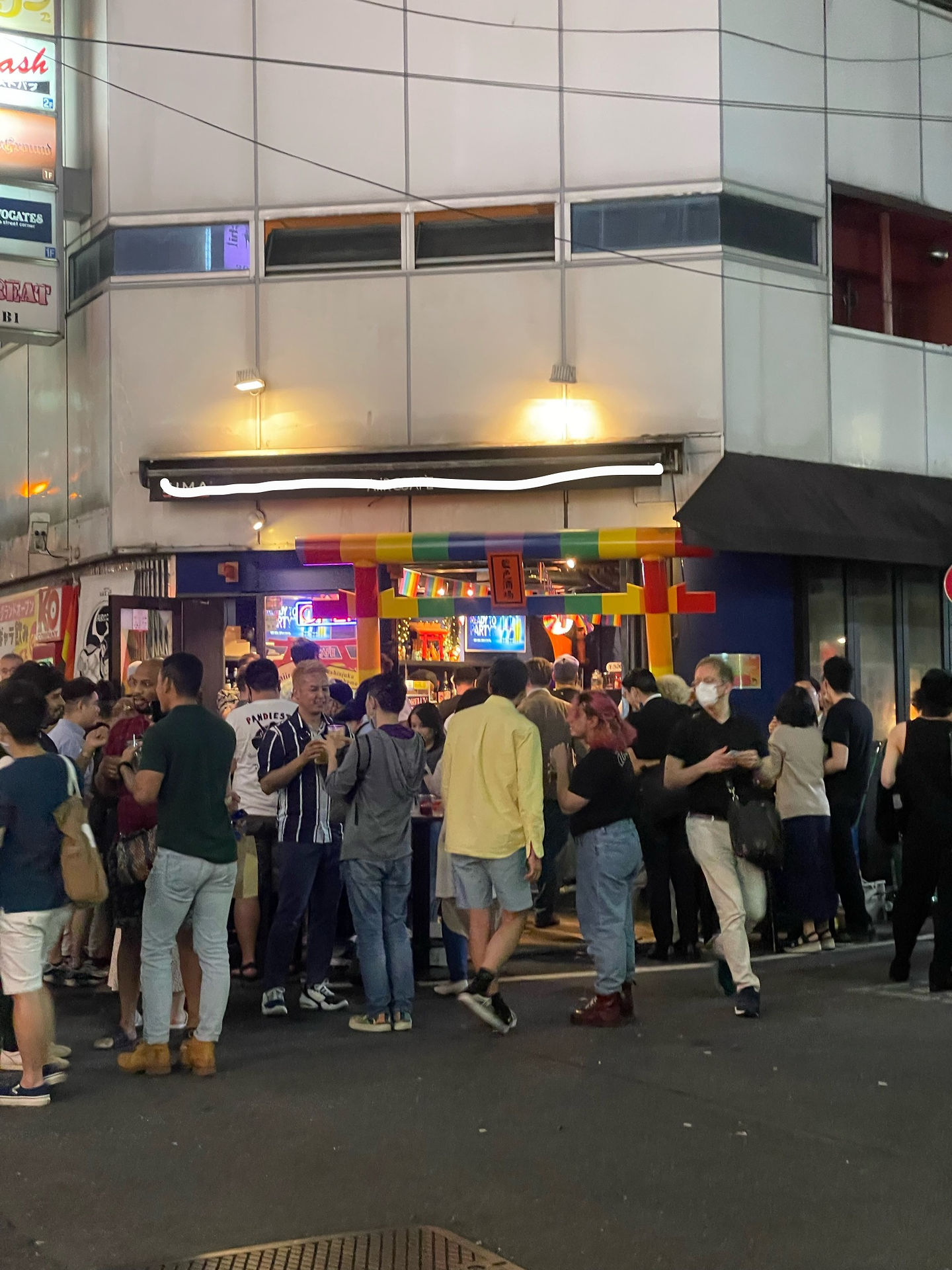
.png)
Maneuvering of Sexualities (Karen)
Expression of Sexualities
Introduction
“なんなの?” or translated, “What are you?”
This was a phrase I encountered twice whilst doing field research in Ni-chome. This question was referring to my sexuality, what sexuality I am, who I am interested in, and what do I identify as. I noticed that this question was asked in one way or another, to many of the patrons visiting gay bars.
In a place such as Shinjuku Ni-chome, where the image of the place is where people in Japan can express their sexualities, it is vital to look into how people are actually doing so as an expression of sexualities is not always explicit knowledge. As illustrated in the other sections, there are reasons sexual identities must be protected in Nichome including risks that arise from the prominence of outsiders and strangers. As mentioned in the section about protecting personal identity, how one expresses sexualities has to do with protecting identities as well. In this section, I will lay out the explicit, as well as the implicit ways sexualities are expressed.
Implicit and Explicit Expression of Sexualities
Explicit Expression
We can never truly know the sexual orientation of someone until we are told by that specific person. Sexual orientation has to do with the internal emotions of an individual and thus it is not about outward expression. We can spend all day judging and assuming someone’s sexuality through their tone of voice or way of dress. However, interpretations are different for every individual and even for the person conducting that expression. Therefore, the only true way to know the sexual orientation of someone is through verbal confirmation, thus the sole explicit expression of sexuality seems to be verbal confirmation.
Verbal Confirmation
Verbal confirmation, I observed, occurred when bartenders or patrons explicitly asks.
In a gay bar, patrons, especially those who do not outwardly express sexual orientation, were asked in conversations. Although the actual phrase “what’s your sexuality?” was not used, after several rounds of ice breaker questions, they asked, “what are you?”, alluding to sexual orientation. When patrons do not outright answer, they give possible answers for individuals to confirm or deny, such as “girls?” “Both?”, or even “does it depend on the time and situation?”
In another gay bar, sexualities were almost pushed onto and out of individuals. Patrons and bartenders were asking individuals their motives and then asking for specific sexual orientations such as “Gay?” or “Into girls?”.
When patrons answer these inquiries, that is when there is an explicit expression of sexualities. These explicit expressions are usually done when one is comfortable in their own sexuality and comfortable with the surrounding environment enough to say it out loud and expose themselves.
Implicit Expression
“…cues to sexual orientation manifest in behavioral (e.g., clothing choices) and structural (e.g., facial morphology) signals.” (Rule, 2017, p.129).
As Rule illustrated, sexual orientation is not merely a feeling one expresses at times. It can be seen in one’s actions or appearance. In contrast to explicit expressions, there are ways people are unknowingly, or many times knowingly, expressing their sexualities such as through their gestures, language, or clothing. in the context of Ni-chome, this is perhaps done to illustrate association with the LGBTQ community for the insiders and those who know and to sort of hiding it from the outsiders. As this whole sexualities page has been illustrating, there are risks involved in outsiders knowing one’s sexuality. Perhaps it is because by judging face information either an individual felt as though they would not be safe to be open or are trying to test the waters and see the reactions of others to their implicit and subtle expression of sexuality. Being “out” in Japan comes with many risks as discussed in the Risks section. Therefore, it is difficult for people to be completely be open about their sexuality to everyone as it can be a cause for conflict both emotionally and physically with other people there. Therefore, to show their sexuality to accomplish the goal of making friends or finding partners, but at the same time protecting this personal information becomes vital in Ni-chome. That is why the idea of implicit expression exists.
Stereotypes
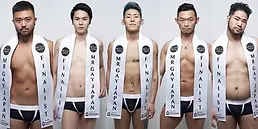
These implicit expressions thrive due to the existence of stereotypes surrounding the LGBTQ community. For instance, when you think of Gay men or more specifically, Japanese gay men you may think of the images on the right.
There are certain ways of dress, haircuts, and body shapes, that go along with the word “gay”. This is true for actions as well, such as flamboyant gestures or crossing of legs. As well as the tone of voice, which can be seen as higher for stereotypes of gay people.
Therefore, through these stereotypes, when an individual conforms to or performs these stereotypes, people have a mental cognition that connects the actions and people to LGBTQ. That is what implicit expression essentially is, doing things (note; not all the stereotypes at once) that are associated with the LGBTQ to subtly show they are a part of the community.

Appearance
Walking around Ni-chome, you will see people dressed in heteronormative casual wear, men in heels, people in drag, and an abundance of fashion styles. When people are rocking the rainbow symbol, wearing eccentric clothing, or wearing items that go against the gender norms, it is representative of the ideologies the LGBTQ community stands for, and thus expressing the community they are a part of, hinting to their sexualities. This is an idea by Rule, who states that “…an apparent rejection of traditional gender roles can convey gender nonconformity, leading to the impression that one identifies with a sexual minority group.”(Rule, 2017, p.130). Here are some of the fashions found in Ni-chome that expressed these ideas.
Types of Fashion Found in Ni-chome:
Casual
There are many who wear “casual wear” in the general sense that they are wearing shirts and pants appropriate for casual outings. These styles can be found in most places aside from Ni-chome.

Drag
There were some drag queens who were usually catches or store owners, although it should be noted that we were unable to visit specific drag bars or clubs so our information is limited. Drag queens are a hobby/occupation and representatives of the LGBTQ community.

Showing of Skin (Shorts and T-Shirts)
There are both men and women, but primarily men, who show more skin than others. This is done through wearing shorts or short-sleeved shirts, which can be seen as a strategy to entice potential partners, which may be men for the men and women for the women, indicating homosexuality.

Gender Bending
There were people wearing clothing items that went against the gender norms such as biologically male-gendered people wearing heels or dresses that are stereotypically associated with women.

Cross-dressing
There were a couple of people who were cross-dressing, primarily male cross-dressers. They are different from drag queens as the queens are doing it for a temporary performance while cross-dressers may be doing it for pleasure.

Eccentric Patterns
A common idea I found from people in Ni-chome is that there are many who wear eccentric patterns such as the person in the shirt here. This is not a typical fashion for men in Japan and can indicate the flamboyance of the LGBTQ community.
Language Use
Another way is the usage of language and tone of voice. How someone says a phrase, especially when it is in a higher pitched tone of voice for biological men, it can indicate flamboyance, which again, goes against the gender stereotypes. In one particular gay bar, we observed the usage of folk terms, which created a line between homosexual and heterosexual. In this instance, the bartenders and a patron were trying to figure out the newcomers’ sexualities, but the newcomers were not being clear with their wording. Their little words and body language showed that they may not be completely straight. So in conversation, they used the words ビアン (bian — lesbian) and ノンケ (nonnke — heterosexuals), which are cultural terms a part of the Japanese LGBTQ community.
まぁノンケが多いよねあのバー。もしあそこにあるバーいったら同じビアンがいっぱいいるし。
(translation: “Well I guess there is a lot of nonnke (straight people) in that bar. But if you go to the other bar there’ll be a lot of bian (lesbians) like you.)
The patrons did not reply in regards to these terms specifically, indicating that they may not have known these words. Without the same cultural understanding, it is indicative of not being a part of the same culture, thus they may be labeled as outsiders by the bartenders and patrons.
So when talking to them, the bartenders used words such as ビアン (bian — lesbian) or ノンケ (nonnke — heterosexuals) which the patrons seemed to be lost about. As these two specific words are more cultural terms used inside the LGBTQ community, those that are not in the community will be distinguished through their knowledge of the words.
Body Language
There is also usage of body language. In the field, we observed in one gay bar three ways body language was particular to the LGBTQ community. When sitting down, from an initial glance we observed that some of the male patrons had their legs crossed. Now, the crossing of legs is socially seen as a feminine body gesture as it involves the ideas surrounding genitalia. Going against their social norm is, as mentioned by Rule (2017), an indication of being non-heterosexual. It is also a stereotype for gay men to cross their legs in the LGBTQ context. Then we observed that some of the male patrons were using flamboyant and over-exaggerated hand gestures such as the flicking of hands which is another stereotype socially associated with homosexual men (Source). Lastly, we saw that there were subtle looks being exchanged between same-sex individuals, who are most likely potential love interests and targets to them. Eye contact is a flirting tactic and therefore, who one does that to is indicative of their sexuality (Source).
Conclusion
As Rule (2017) has illustrated, there are many subtle ways to express sexual orientations. In Ni-chome, we can see that idea of being present as people are not only explicitly “coming out”, but people are also presenting themselves implicitly through their appearance and behavior. Having this cultural knowledge that one in the community must know in order to freely navigate the space, successfully excludes outsiders who are unaware of these subtle expressions. For people in the LGBTQ community, in Ni-chome, it is important for them to sort of hide their sexualities as outsiders can be seen as a risk and threat as their intentions are not very clear. Therefore, controlling how they express their sexualities is one method insiders use to minimize their risks in interactions with strangers in Ni-chome.