.png)
Heterosexual inclusion/exclusion (Momo)
Heterosexual Activities in Nichome (Needs of Straight)
Introduction
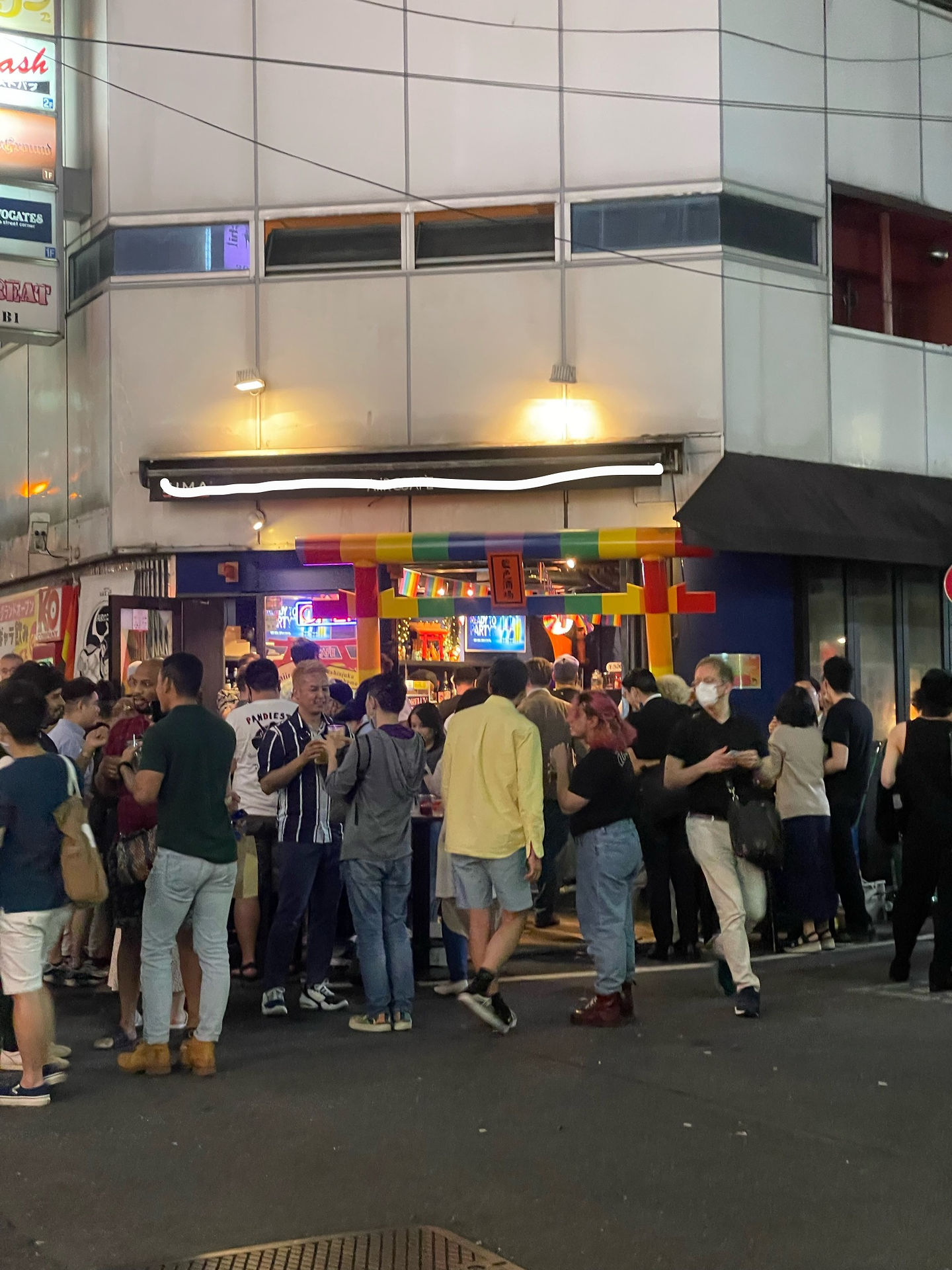
Straight people were observed engaging in a variety of activities in Nichome. One time a heterosexual couple was peeking through gay bars. Another time heterosexual men were hitting on women outside the gay bar. Through the analysis of heterosexual activities, this page outlines the needs of straight people. In maintaining the customer base for the sustainment of their business and community, it is essential for bars and clubs to understand the needs and wants of straight patrons and provide service to fulfill such demands. Moreover, to maintain heterosexual tourists for more profits, the practice of heterosexual exclusion needs to be done in a manner that partially respects the needs of straight visitors. Thus, this page introduces the needs of the straight customers, which will be used in examining the inclusion and exclusion practices in later pages.
Consumption of gay culture

Lack of exposure to the LGBTQ+ community and culture in day-to-day life ( due to low social and legal acceptance of LGBTQ+ in Japan) may be a reason for some heterosexual people to develop a curiosity for gay culture. Or it may be straight people’s yearning (Akogare)for homosexuals owing to skewed queer representation on Japanese media (McLelland,2003).
Some bars in Nichome are labeled tourist bars [Kankou ba]. Most of Kanko ba has Onee staff dressed in provocative clothes and wearing bold makeup. One particular tourist bar Nature-y! Bar, is almost always filled with heterosexual customers. An Onee staff and the gay bartender in pair hold a conversation in so-called Onee go (gay male speech).
Sunakawa (2015)defines Kanko ba in Nichome from the viewpoint of gay insiders as follows:
“The bar that acknowledges the eyes of straight customers and meets the expectations of those eyes, while serving customers through the construction and presentation of "gay behavior" that can be called ‘gay performance’”[ノンケ客という他者の視線を意識しつつ、その視線の期待に応じつつ、「ゲイ的な演出性」とでもいうべき「ゲイ的な振る舞い」の高度な構築と提示を行い接待をするバー”] (Sunagawa,2015, p.192)
Thus, tourist bars in Nichome successfully serve the needs of curious straight patrons by sometimes exaggerating “gayness” to fit the heterosexual expectation of gay culture.
To find comfort and safety - Nichome as a safe space for women-
My first experience in one of the most lively gay clubs D can be summed up in two words: safe and fun. Because of the understanding that men at the club will not be interested in women, I felt free from the male gaze or anyone’s gaze present in a heterosexual space. No patrons there stared at us, offered us drinks, or gave unwanted attention. I did not have to worry too much about my safety the way I do at normal bars or clubs.
For heterosexual women, in particular, gay bars and clubs offer safe nightlife experiences. In normal bars and clubs where alcohol consumption naturally comes along, women are exposed to dangerous behavior of men such as abuse, harassment, and assault. As a result, experiences of women at nightclubs are almost always constrained by potential risks posed by the surrounding men and their behavior. Therefore, the absence of heterosexual men gives a sense of comfort and safety to heterosexual women, allowing for clubbing and drinking experiences without being subjected to sexualization and objectification by men. The following quotes similarly illustrate the needs of straight women in gay-oriented spaces and friendships, respectively;
“While a much-cited reason for the popularity of gay men and gay bars with heterosexual women is that they do not have to fear […] advances from them, fear of harassment does play a role with especially young gay men in relation to visiting gay bars and especially hattenba” (Lunsing, 2005, p.62).
“The sense of comfort perceived in the (heterosexual women’s) relationship with gay men lies in the absence of [intimate] desire or romantic feelings between the two parties.” [ゲイ男性との関係の居心地の良さのひとつは、ヘテロセクシュアル男性と違い、お互いに性的欲望や恋愛感情を向け合うことが無い、という点に見られる](Kato,2008, p.64 )
The topic of money was often brought up, particularly at tourist bars. This indicates that the economic status of patrons is widely observed to determine the quality of services as well as the degree to which the patrons will be included.
Men
In the tourist Onee bar Nature-y! Bar, the bartender asked a heterosexual man “When is the last time you had it”. It was his first time visiting the bar and talking to the guy. Questions on highly private and personal information continued. Such questions were never asked to the straight patron’s female friends also present at the time.
Although some male patrons may find it uncomfortable to talk about their life with strangers at the gay bar, it was evident that in that particular tourist bar male customers get far more attention than female customers especially when the intimate talk is being held.
Sunagawa (2015) demonstrates that intimate talk between gay bartenders and customers in Nichome is a means to build an intimate bond [親密な絆を構成するための手段](p.295). Although Sunagawa strictly talked about the role of intimate talk within the gay community, it seems that gay bartenders similarly communicate with straight male patrons through sharing of personal information. As discussed, it is quite common among bartenders to assume the demographic characteristic of the customers. Thus, with or without direct question on their sexuality, a straight man can be assumed gay by the bartenders, which in turn results in gay-bar-specific bounding conversation based on personal information sharing. Thus, in gay bars, straight may get easily included compared to their female counterparts owing to the shared gender identity.
Japanese fluency
Despite the prevalence of foreign tourists, bartenders often do not talk to the customer unless they speak a little bit of Japanese.
As we walk into the gay club D, we were talking to each other in English. As we discuss what to order in English, the bartender behind the counter awkwardly checked on us. When we finally raised a hand and said “すいません” in native Japanese, the bartender raised his eyebrows and looked surprised. After figuring out that we speak Japanese, he asked about our ethnicity and background. The conversation went on until we left.
Although some bars are highly international and bartenders and servers themselves are non-Japanese, thus fluent in English and other non-Japanese languages, many tourist bars provide services in Japanese. Bartenders may not be intentionally exclusionary to English speakers; however, the language barrier inevitably hinders communication.
Conclusion: Liberation from the heteronormative world
Heterosexual patrons find a wide variety of activities to engage in Nichome. The observed activities ( except for finding hetero partners) underscore the overall needs and wants of straight people: liberation from a heteronormative world. Straight woman seeks a safe nightlife experience, while straight men find a space of refuge in Nichome from heteronormative masculinity. In other words, the influx of straight people into Nichome unveils dissatisfaction straight people face in the heteronormative society from the relationship with heterosexual men/women to the traditional gender norms.