.png)
Ways for bartenders to create intimacy
with customers
.png)
by Christina
Introduction
“All the world’s a stage. And all men and women are merely players”
- Shakespeare from As You Like It
With Goffman applying the language of theatre to sociology, the “dramaturgical” view of interaction, assumes that people are regularly manipulating meanings in social interaction; excluding information that could be deemed as damaging, therefore, maintaining appearances that will help formulate definitions of the situation. Goffman argues that people have a repertoire of identities, choosing the one that will appear most ‘proper’ depending on the given audience. In other words, “individuals have some motive for trying to control the definition of the situation that others will come to have” [emphasis added] (Karp, 2015, 91). Raising this sociological perspective, this sort of interaction is observable in bars and clubs in Ni-chome. However, what is to note is that the dramaturgy presented is an unequal one: the stage is already set and the service providers fully understand their roles, but most importantly, who to project to their customers.
Similar to any other occupation in hospitality, serving drinks is physically and mentally demanding work, requiring so-called emotional labour and emotional management due to usually having direct contact with customers in the forefront (i.e., the bartending station).
Emotional labour:
“Requires one to induce or suppress feelings in order to sustain the outward countenance that produces the proper state of mind in others” (Hochschild, 1983, as cited in Guptill, Copelton, & Lucal, 2017, p. 51)
Emotional labour is to learn what the guests’ needs are and to put them at ease, observe and interpret the customers’ behaviours and expressions (so-called face information), infer mood and motive, and respond appropriately to social cues. In short, it could be described as a “service with a smile” mentality; a commodification of human emotion.
Also, where the service providers are not only working for themselves but are also concurrently working for the institution. Nevertheless, it could be deduced that showcasing the transparent tip jars–filled with cash and coins–reflects the bartender’s success in creating intimacy with their customers.
Mentioning this, some scholars have argued that customer service interactions are in essence, “double-edged in that they possess the potential to be subjectively satisfying as well as distressing for the worker” (Brook, 2009, p. 8). In other words, not all human emotions, appearances, and sexuality are commodified in the labour process, allowing service providers including bar staff to exercise their agency to an extent.

Tip jar spotted in Dragon Men Tokyo; there were 8 surrounding the bartending station.

Tip jar spotted in King Tokyo Bar; there were two on the bartending station.
While there is the controlling of the appearance of ‘oneself’ in the aforementioned dramaturgy, there is also a manipulation or even transgression of the ‘stage’–the so-called territoriality of the bars and clubs. As depicted below, there are designated bartending stations for these bartenders and seating areas as well as open spaces for patrons. However, in the case of Dinosaur Men, there were accounts where the bartender would leave their station to see off or talk to the customers in the seating area near the window side; for Nature-y! Bar, drag queens are seen sitting at the tables and seat area, conversing with the customers; and for Princess Paris, the manager, in particular, is seen to be merging in with the customers by sitting with and leaving the facility.

Layout of Dinosaur Men

Layout of Nature-y! Bar
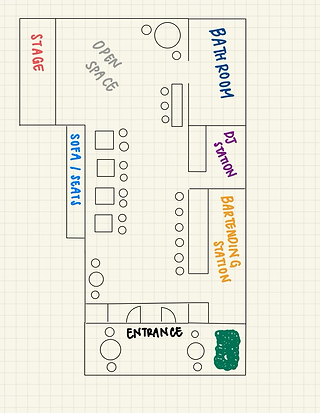
Layout of Princess Paris
Territoriality:
Space that is defined, allocated and maintained (Spradley and Mann, 1975, as cited in Duneier, 2014, 169)
Introducing themselves
“Hello guys! My name is Takeshi and I am the manager here”. It was a Thursday night, around 10 PM when the Columbian man approached two customers–a female and a male–sitting at a table further away from the bartending station; Takeshi, the manager of Princess Paris, had left from behind the bar to the open floor where all the customers, including the two, were drinking, conversing, and even dancing (with a lot of lower body movement) to the upbeat Hispanic music.
Navigating around the open floor of the bar, Takeshi began to introduce themselves to first-time comers of the bar, including myself.
Approaching three salarymen, Takeshi began introducing himself to them as well. Contrasting to when he introduced themselves in fluent English to me as well as the two aforementioned customers, Takeshi used fluent Japanese to talk to the three salarymen.
“Why are you so good at Japanese?”
“Because I was born and raised in Japan for 18 years,” Takeshi said while standing at the three salarymen’s high-top bar table, merging with the customers.

Takeshi introducing himself to a customer
Questioning and making assumptions about the customer

The bartender also wore socks to work that are seen frequently in the district.
Questioned
Being called into Dinosaur Men by the bartender, they waited until the group of females they invited to be seated. Once the females were comfortable in their seats at the corner of the bar/club, he asked the burning question: “What are you?” (「なんなの?」)
The man, wearing rainbow socks as an expression of his sexuality, anticipated their answers.
Although not explicitly mentioning the word ‘sexuality’, the question alluded to the patrons’ sexual orientations; the patrons knew what was being asked.
Attending their customers, to another pair who were sitting at the bartending station, the service provider asked, “どこからの出身ですか?” (“Where are you from?”), to learn more about the pair’s ethnicity.
Read more on the
Assumed:
In a drag queen bar called Nature-y! Bar, despite being promoted as a bar for tourists (観光バー) and thus, assumed to be accepted for speaking English, the customers–three females and one male–were faced with a rhetorical question “ちゃんと日本語喋ってる?” (“Are you properly speaking in Japanese?”)
Being brought to the service providers’ attention, instead of being questioned about their sexual orientation and ethnic identity like at Dinosaur Men, it was instead assumed.
Utilising jokes
Self-deprecating humour:
While the manager of Princess Paris was talking to the aforementioned three salarymen, he felt his cue to leave the table after explaining his background. While doing so, he turned about and started patting himself:
“麻薬?” (“Drugs?”)
He knew of the stereotype Columbians have and utilised that as a joke for the patrons he was talking to laugh and feel closer to the manager.
Camp humour:
Following the assumption that the patrons were non-Japanese, the bartender utilised different humour compared to Princess Paris. (Note: this is a mild example)
According to the patrons, they felt as though the humour used in Nature-y! Bar was similar to that of マツコ・デラックス, a famous personality, well-known for his cross-dressing stage persona.
What is meant by this is perhaps the utilisation of manzai, a Japanese comedy that uses a duo (in this case two groups–customers and service providers), arranging one group as the ‘boke’ (the fool who is mentally slower) and the ‘tsukkomi’ (the person who grills the boke).
By using such a strategy to bring the people into the uchi (i.e., by having them be part of the ‘inside’ joke), it seems as though the customers were put into the position of the fool, perhaps as an attempt to see whether the patrons themselves would get the hang of the so-called humour.
🗣️
「日本じゃないよ」
“I am not from Japan either”
「どこですか?」
“Where are you from?”
「北朝鮮…」
“North Korea…”
「え?!」
“What?!”
[inaudible]
「違うのか。全然信じた。」
“So you’re not from North Korea. I totally believed it.”
Shaking hands
Upon introducing himself to the customers, Takeshi reached out their hand as a means to shake the patrons’ hands.
With a firm grip and strong eye contact (and of course, with a smile), he could be heard from a distance:
“You can come to me or my staff if you have any problems”.
Failed attempt:
However, one male customer in specific did not seem to want–or was too slow–to shake hands with the manager.
To avoid the awkwardness of being declined to have a more intimate relationship, the manager pivoted and said
“Oh, so you don’t like? It’s okay.”
Then turned his attention to the other patron; the manager was not seen to be talking to them again after this interaction.
Conversing
In all bars, conversing is necessary, depending on their objectives.
From the bartenders’ side, there were observations of a few topics they touched upon through eavesdropping.
1. “Girls’” talk (恋愛話)
There were also accounts of bartenders asking about the patrons’ love life.
Failed attempt:
Knowing the patron, the bartender starts off his conversation with two young men sitting at the counter with 「久しぶり」
The familiar’s friend brought up his girlfriend midst their conversation:
「彼女いたの?」
“You have a girlfriend?”
「はい、彼女います。」
“Yes, I do have a girlfriend”
2. Intimate talk
3. Race, ethnicity, and nationality
As there are foreign people–both tourists as well as residents–there is a lot of conversation revolving around race, ethnicity, and nationality.
Read more on Accepted Behaviours
(this includes conversation topics).
Drinking
With a pair sitting at the bartending station, the bartender of Dinosaur Men started pouring himself a drink after serving the drinks to the pair. It looked to be champagne, served in a tall long glass.
“乾杯!” (“Cheers!”) all three exclaimed loudly.
Although working–behind the bar–not only is he able to utilise his surroundings but is also seen to be drinking during his work.
In contrast to this, service providers at Princess Paris were also seen drinking during the site, but they were not seen clinking drinks with customers behind the bar.
Hugging
On many occasions, the manager of Princess Paris was seen to leave his station to welcome and hug regulars.
“It’s good to see you! How have you been?”
Other service providers were also seen transgressing the stage by hugging people on the ‘frontstage’. When one group of Spanish-speaking men were leaving the bar, one male service provider hugged an individual from the group; the hug lasted for 5 seconds.
Such an occurrence–of hugging familiars while there are other customers–during working hours would usually not be seen in other bars and clubs outside of Ni-chome.
Providing food
Who doesn’t love to connect with others through food?
Although not able to join physically, the bartender at Dragon Men provided us as well as other customers with complimentary snacks, this time, the Japanese snack called 柿の種.

Dancing
While greeting regulars when on the dance floor, the manager of King Tokyo was seen at times, shaking his hip side-to-side:

Another service provider in the same bar was observed to join a group of customers–who were dancing on the open floor–and joined them for a few seconds before going back to clean the tables with his 雑巾 and alcohol spray.
Letting customers change the music
Asking customers what music they would like to play:
As it was a Thursday and there were fewer customers compared to the weekend, the bartender at Dinosaur Men, left his bartending station to approach four females who were sitting and conversing with one another.
“Do you have any music you would like to play? If so, could you let me know the name?”
After a few minutes of the females arguing about what music they would like the venue to play, they said with excitement: “The Weeknd”.
It was then realised by the patrons that the music played was the whole album by The Weeknd. One female in specific said “Since it is pride month, I think we need to be on brand–let’s ask for him to play Lil Nas X”. After a few minutes of attempts to get the bartender’s attention–who was speaking and serving other customers–the females were able to change the music to Lil Nas X.
Customers manipulating the stage when changing the music:
While observing around the area, I saw that a man extended their hand out into the back of the bar, with no “can I change the music?” or “excuse me”.
Instead, they reached for the iPad, located behind the menu tablet and headed back to the seats outside where he and his friends were sitting.
Holding the tablet for a few minutes, he received song recommendations from those around him. Afterwards, he returned the tablet without any mention of it and the manager/service providers also did not bring it up… is the man also a service provider?

Manipulation of the front and backstage (territoriality)
Conclusion
Through the sequence of the ways bartenders create intimacy with their customers, it could be illustrated how bartenders transgress the allocated space and utilise their token of the relationship with the customer as an attempt to bring them into the uchi, regardless of whether part of the LGBTQ+ community or not. By creating such intimacies, some customers themselves were seen to be also manipulating territories in the bar/club. Therefore, the bartenders play a significant role in shifting the position of the customer within the community in the bar/club.